
The Merchants of Haymarket: Putting Sydney's Chinatown On The Map
禧市商人:造就悉尼(雪梨)唐人街
Chinatowns around the world have long held a fascination as enclaves of intrigue, of food and culture and a vibrant commercial spirit. The same holds true for Sydney's Haymarket Chinatown, which relocated from the first Chinese settlement in The Rocks at the latter part of the 19th century.
Beyond the familiar narratives of early Chinese-Australians as gold diggers, market gardeners, hawkers, cooks and cabinet-makers, the inaugural exhibition at the Museum of Chinese in Australia (MOCA) reveals the lesser-known early history of Haymarket Chinatown.
The "Haymarket Merchants: The Making of Sydney's Chinatown" exhibition honours the Chinese merchant families who built the district during the difficult decades when successive Australian governments sought to restrict the immigration of non-whites under the so-called White Australia policy.
Despite that obstacle, Haymarket prospered thanks to a number of Chinese associations, businesses and the families behind them that flourished along Campbell, George, Dixon, Hay, and Sussex streets. They included Mei Quong Tart's tea rooms, mixed business Kwong War Chong & Co. (1883–1987), fruit merchants Wing Sang & Co. (1890–1984), home furnisher Simpson Lee & Co. (1910–1954), and the Modern China Café (1940–1965).
These merchant families and others –– including the few pioneering mothers and daughters –– built their businesses and homes in Australia by leveraging entrepreneurial skills, family clan networks, and transnational connections. They not only adapted and survived; many thrived,
creating one of the most exceptional Chinatowns in Australia.
The foyer exhibits feature a range of selected objects and images from these merchant families. The full exhibition is located in the Level 1 gallery.
悉尼(雪梨)禧市唐人街(Sydney's Haymarket)是十九世纪后期,由华人第一个聚落地 - 岩石区(The Rocks)迁至。世界各地唐人街一直是充滿魅力,被视为神秘、美食、文化以及充滿活力的商业中心,悉尼(雪梨)禧市唐人街也不例外。
除了人們熟知早期澳洲华人淘金者、菜农、小贩、厨师及家具工匠等形象外,澳洲华人博物馆(MOCA)开幕展,将呈显及展示悉尼禧市(雪梨禧市/Sydney's Haymarket)唐人街鮮为人知早期历史。
【禧市商人:造就悉尼(雪梨)唐人街】展览,紀念在澳大利亚历屆政府推行「白澳政策」以限制非白人移民的艰难时期,建设了这片区域的华人商戶家族。
尽管面临重重阻碍,但禧市唐人街依然蓬勃发展,这要归功于众多华人社团、商戶及其背后的家族,他们在衿步街(Campbell Street)、乔治街(George Street)、德信街(Dixon Street)、禧街(Hay Street)和莎瑟街(Sussex Street)等一帶街道上,如雨後春筍般,不断开设不同的生意和店舖。其中包括梅光达茶室(Mei Quong Tart's tea rooms )、杂货店广和昌(Kwong War Chong & Co. 1883-1987)、水果商永生公司(fruit merchants Wing Sang & Co. 1890-1984)、家居用品李氏家族锦顺有限公司(home furnisher Simpson Lee & Co. 1910-1954)以及新中国酒家(the Modern China Café 1940-1965)。这些商戶家族及其他,包括少数具有开拓精神女性——母亲和女儿,凭藉着其商业才能,家族人脈和跨国关系,他们不仅适应并生存下來,在澳洲建立起自己的事业和家园,许多商家还继续拓展其事业版图——造就了澳洲最独特的唐人街之一。
大堂展厅,展出以上商戶家族部分精选物品和图片。完整展览位於二楼(Level 1)展厅。
Chinese Business Associations
中华商会
1892–1965
At the end of the 19th century, Chinese merchants in Sydney formed business associations to engage in charitable work, promote cooperation and campaign against the White Australia policy.
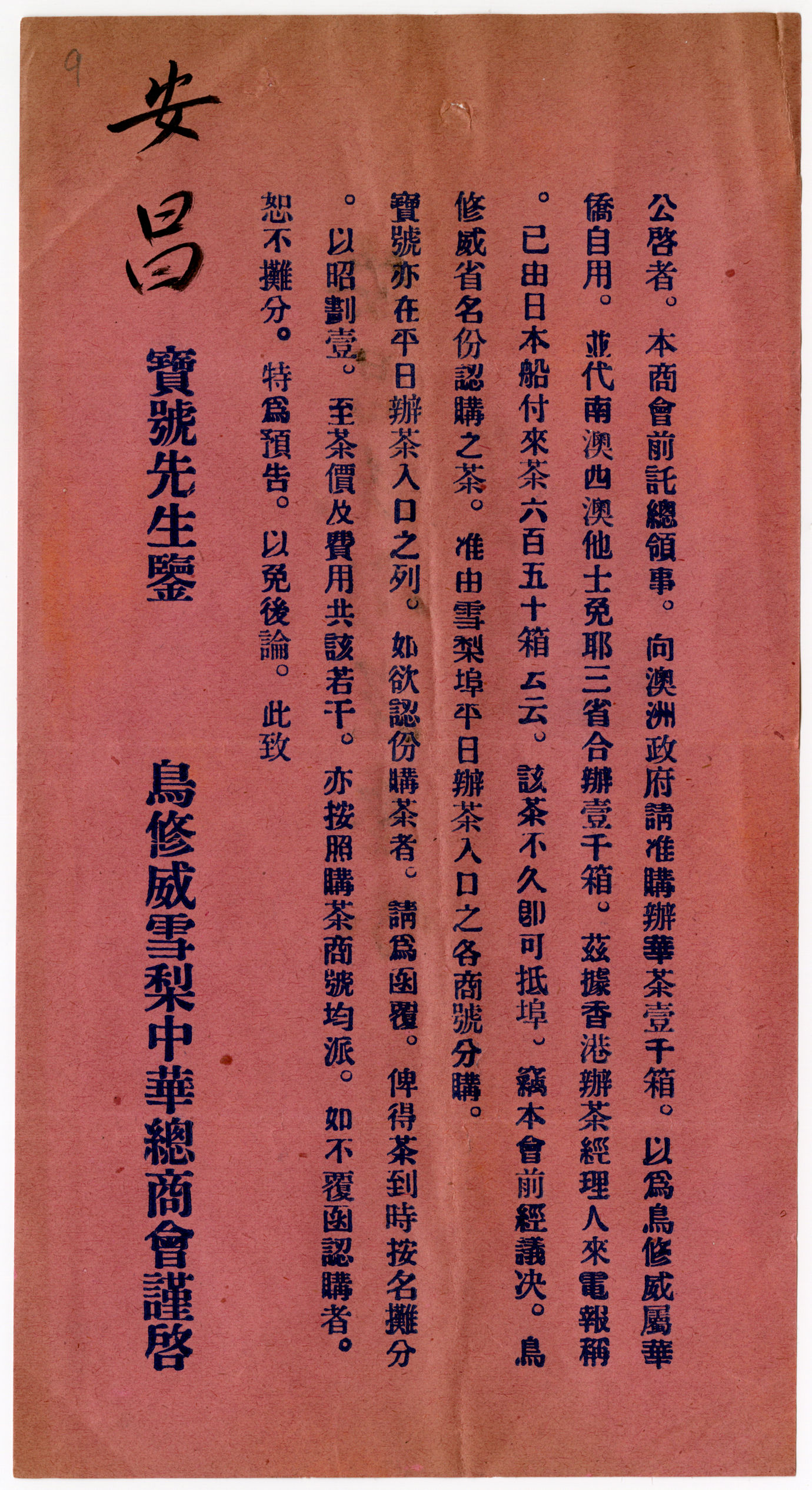
Lin Yik Tong, also known as the Chinese Commercial Association (1892–1903), was the first Chinese commercial association in Sydney, with representatives from eight Chinese import and export trade firms. Among its members were prominent figures such as Mei Quong Tart. After Lin Yik Tong dissolved, it was reformed into the New South Wales Chinese Merchants' Society (1903–1912). The Society fought to safeguard Chinese business against boycotts, and successfully lobbied the government to ban opium imports. In 1913, it became the New South Wales Chinese Chamber of Commerce (1913–1965). Despite political differences, the Chamber united all parties in 1917 to establish the first Chinese-owned shipping company, the Chinese-Australia Mail Steamship Line. In 1924, it also founded the Australia Sydney Chinese School at 52 Dixon Street. The Chamber of Commerce ceased operations in 1965 due to declining membership numbers.
悉尼(雪梨)华商在十九世紀末成立了多个商会,致力于慈善事业、促进合作,并反对「白澳政策」。
联益堂,又称中华商会(Lin Yik Tong,1892–1903)是悉尼(雪梨)第一个华人商会,由八家华人进出口商行代表组成。其成员包括梅光达等知名人士。联益堂解散后,改组成为"鸟修威华人商会"(1903-1912,NSW=鸟修威=新南威尔士),商会积极维护华人商业权益,避免遭受抵制,並并成功游说澳洲政府禁止鸦片进口。1913年,该会更名为"澳洲鸟修威雪梨中华商务总会"(1913-1965),尽管有政治分歧,商会还是联合各方力量,于1917年成立第一家华人资本拥有的航运公司 - 澳中游轮公司。1924年,商会还在德信街52号(52 Dixon Street)创办澳洲雪梨/悉尼中文学校。由于会员人数下降,商会于1965年停止营运。
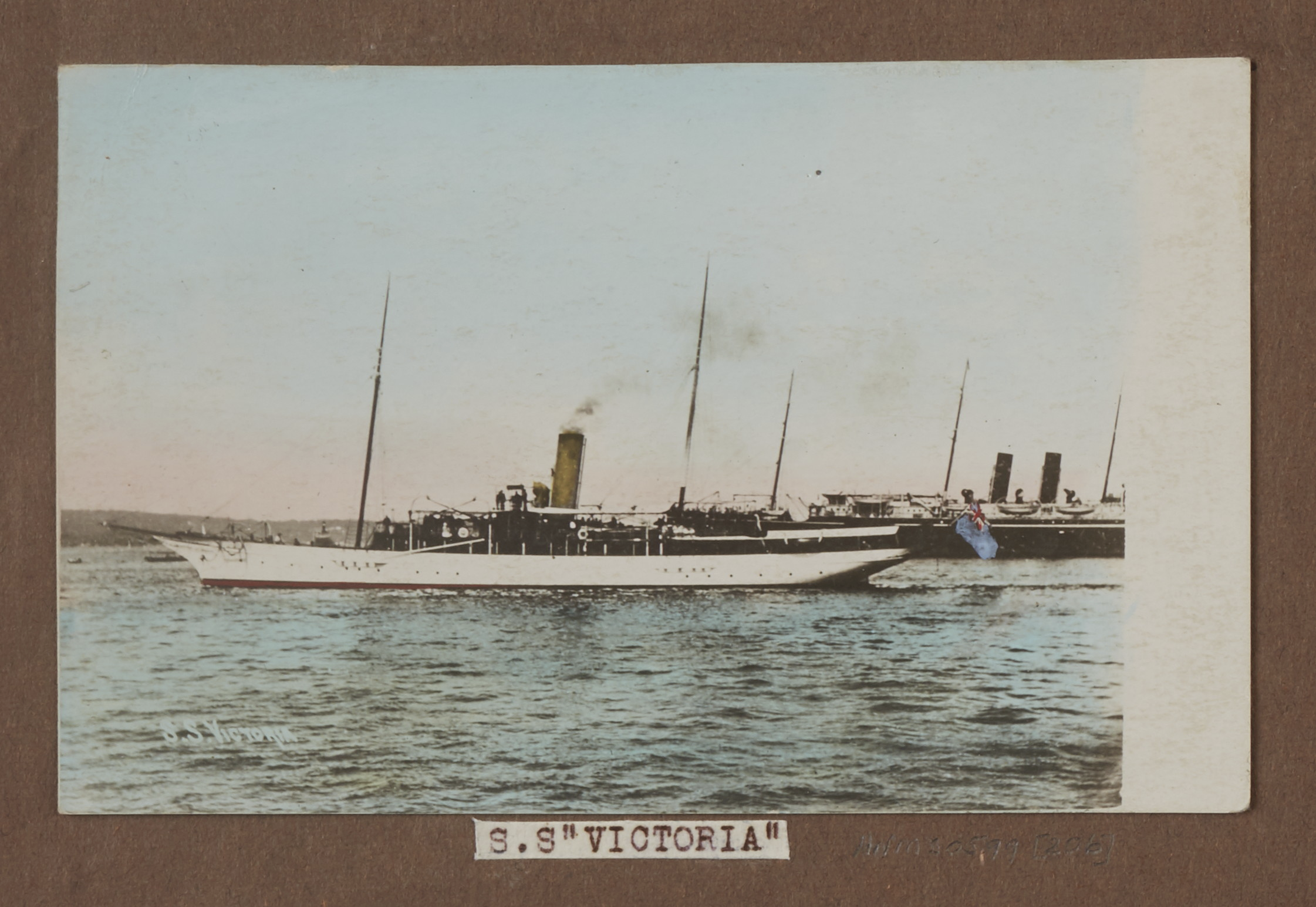
SS Victoria, Sydney, before 1946
ANMM Collection Transfer from the Australian War Memorial
ANMS0599[206], The Australian National Maritime Museum
SS Victoria, Sydney, before 1946
ANMM Collection Transfer from the Australian War Memorial
ANMS0599[206], The Australian National Maritime Museum
Kwong War Chong & Co.
广和昌公司
1883–1987
Kwong War Chong & Co. was a mixed business combining a general store, trading company, remittance agency, and dormitory accommodation. It was established in 1883 on Campbell Street by a group of Chinese businessmen, including Phillip Lee Chun (birth year unknown – 1934), near the Belmore Markets (now the Capitol Theatre). When the new vegetable market (now Market City) opened in 1909, Phillip Lee Chun purchased 82 and 84 Dixon Street — the first buildings owned by Chinese — and moved Kwong War Chong to 84 Dixon Street in 1911. These premises served as a store, a residence, and venue for community gatherings.
Harry Lee and then Norman Lee, sons of Phillip Lee Chun, managed the business from 1932 until 1987. Harry Lee's widow, Eva Lee, together with Wong So Lin Pang, opened the Hingara Chinese Restaurant (1971–2017) at 82 Dixon Street.
Kwong War Chong was a lifeline for Chinese migrants, offering essential services and accommodation. Its buildings reflected the multifunctional role of many Chinese enterprises at the time, serving as a venue for business, and a haven for family and community.
广和昌公司是一家集杂货店、贸易公司、汇款代理及提供宿舍等业务于一体的综合企业,是1883年由李春(Phillip Lee Chun,又名李臨春,生年不详,卒于1934年)和一群华商 共创建,最初店址设在 衿步街(Campbell Street),靠近 Belmore Markets(现为国会剧院)。
1909年,新禧市蔬果市场开业后 (now Market City),李春购入德信街82-84号物业(82-84 Dixon Street),这是华人拥有的第一批房产。广和昌公司也于1911年迁至德信街84号。这些物业既是商店、住宅,也是社区聚会的场所。
从1932年至1987年广和昌业务由李春之子Harry Lee 和Norman Lee先後经营管理。Harry Lee的遗孀Eva Lee与Wong So Lin Pang在德信街82号开设中餐馆"幸雅酒家"(the Hingara Chinese Restaurant,1971-2017)。
广和昌公司及其建築是华人移民的生命线,反映了当时许多华人企业多功能性:提供基本服务和住宿,同时既是商业场所,也是家庭和社区的避风港。

Kwong War Chong & Co. advertisement on The Chinese Australian Herald, celebrating its relocation to 84 Dixon Street, Haymarket, Sydney, 12 February 1910
Courtesy of State Library of New South Wales
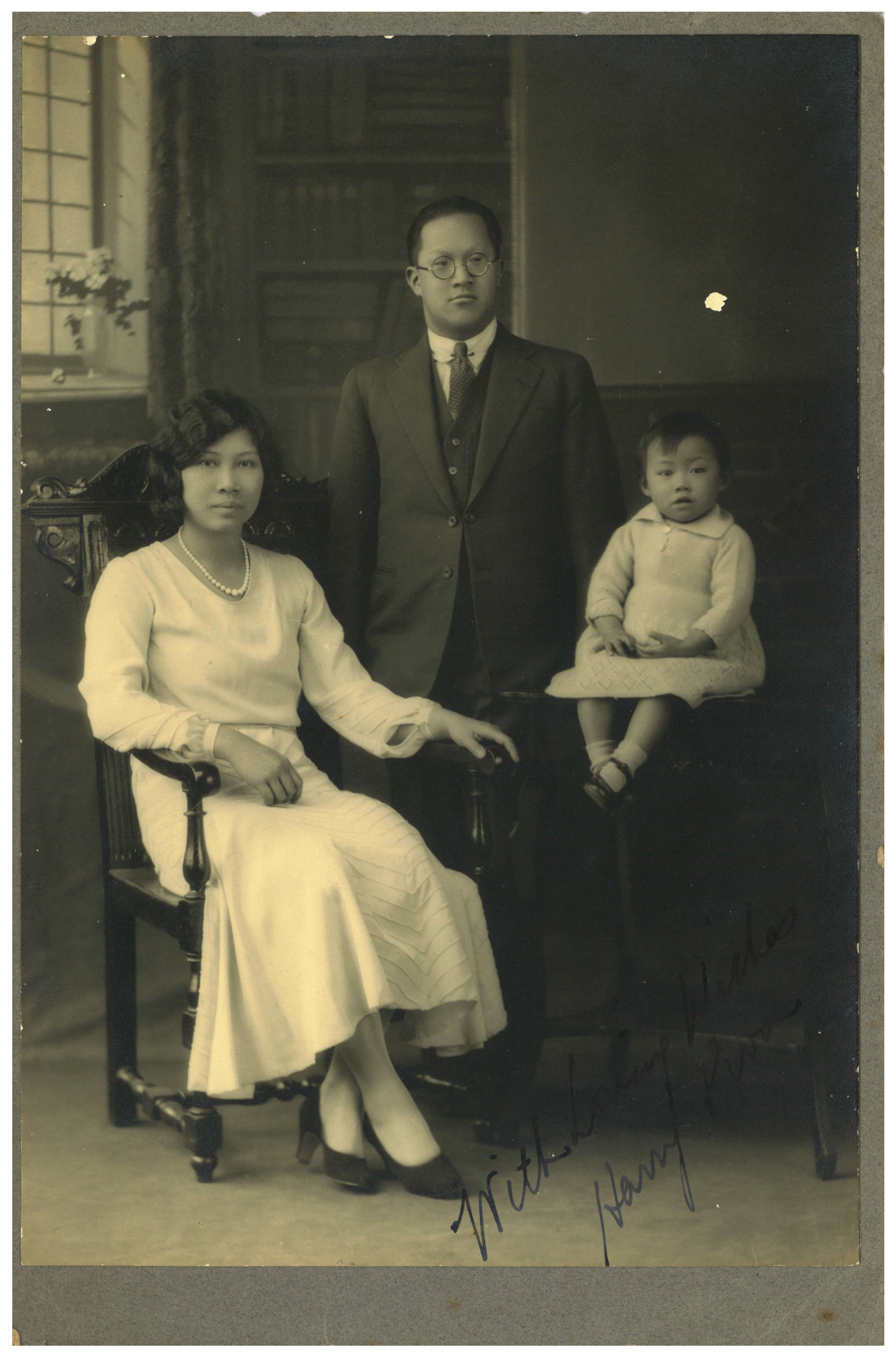
Family photo of Harry Lee, Eva Lee and Julia Lee, Sydney, c.1931
Courtesy of Aileen Ahyong
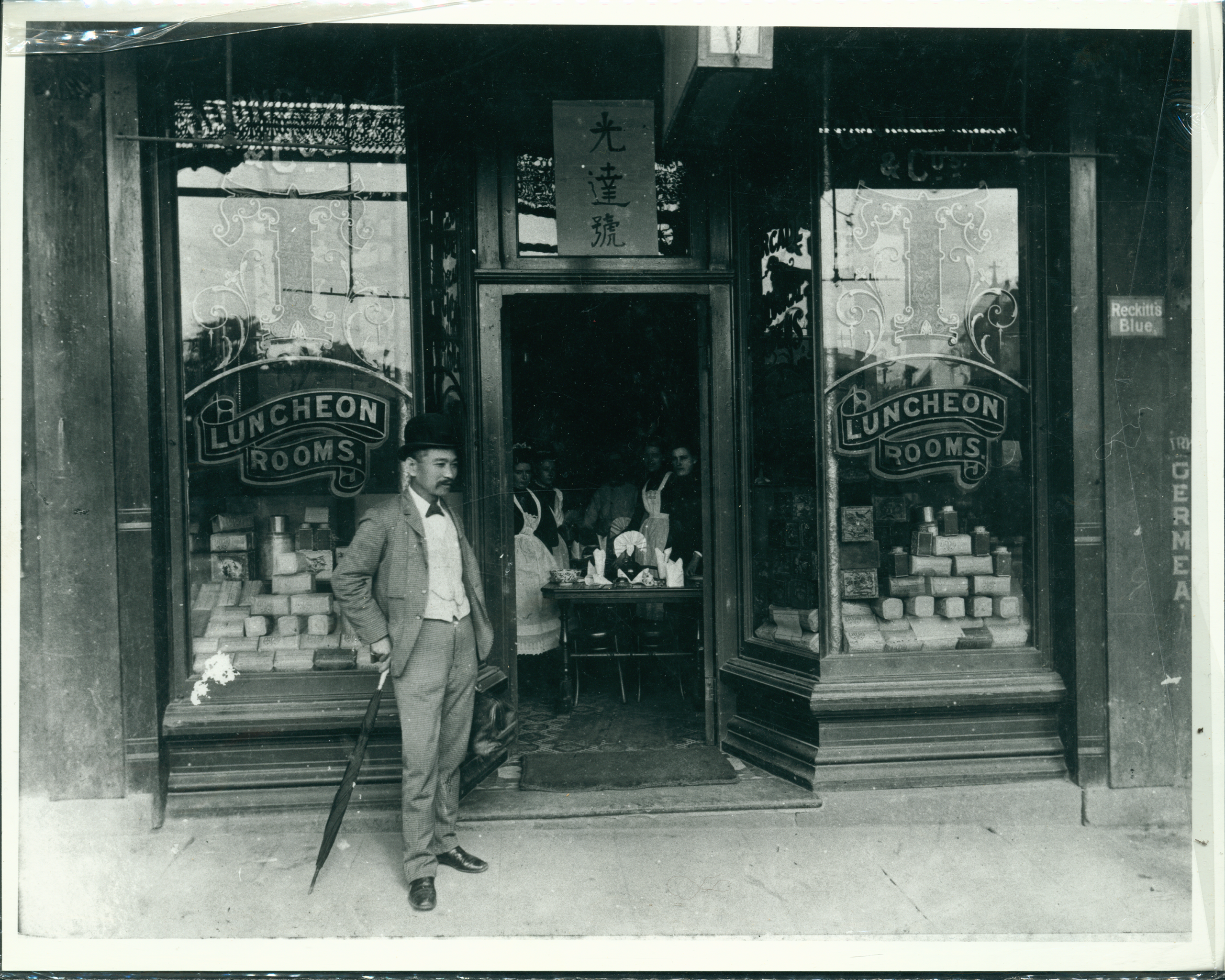
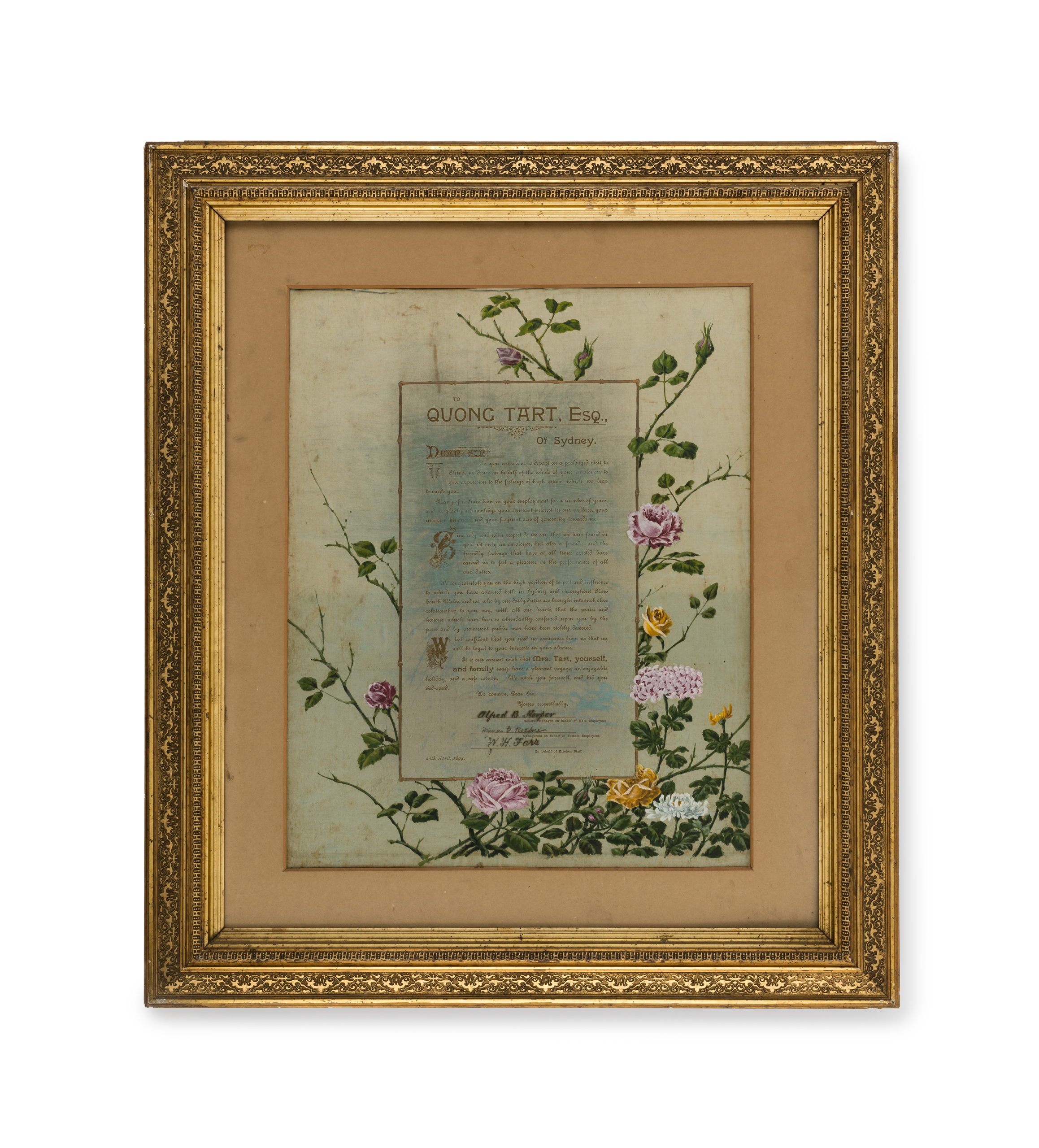
Mei Quong Tart
梅光达
1850–1903
Mei Quong Tart (1850–1903) was a prominent 19th century Chinese-Australian merchant, public figure, philanthropist, and cultural ambassador.
He began his tea business in Sydney Arcade in 1881 and quickly expanded to locations including 777 George Street near Haymarket, Loong Shan Tea Rooms at 137 King Street in 1889, and Elite Dining Room and Tea Rooms in the Queen Victoria Markets (now Queen Victoria Building) in 1898. He was widely recognised for his advocacy of Chinese-Australian relations. In 1894, he was awarded the title of Mandarin of the Fourth Rank by China's Imperial Court.
His tea rooms became important venues for social and political gatherings, including for key members of the women's suffrage movement. Quong Tart passed away in 1903 from complications following injuries from a violent assault in his office. His death was widely mourned across all sectors of society.
Quong Tart's successful teahouses, and his efforts to bridge cultural divides during a period of fierce anti-Chinese sentiment, made him the most influential and respectable Chinese-Australian of his time.
梅光达(Mei Quong Tart 1850–1903)是十九世紀澳大利亚华人杰出的商人、公众人物,慈善家和文化大使。
他第一家茶店是1881年在雪梨拱廊(悉尼/Sydney Arcade)开设,并且迅速扩张其业务,包括位于禧市乔治街777号(777 George Street near Haymarket)和1889年在137 King Street开设"龙山茶室",1898年在维多利亚女王市场(the Queen Victoria Markets/现维多利亚女王大厦)开设分店——"精英"餐厅和茶室。他因积极倡导澳中关系而广受赞誉。1894年,他被中国清廷授予四品官銜。
他的茶室成为重要的社交及政治集会的场所,包括妇女参政运动重要成员的聚会。1903年,梅光达因在办公室遭遇暴力攻击,受伤後后引发并发症而逝世。他的逝世令社会各界深感悲痛。
梅光达先生成功经营和拓展其茶室业务,以及他在反华情緒高涨时期为弥合文化隔阂所作的努力,使他成为当时最有影响力和最受尊敬的澳大利亚华人。
SS Victoria, Sydney, before 1946
ANMM Collection Transfer from the Australian War Memorial
ANMS0599[206], The Australian National Maritime Museum
Simpson Lee & Co.
锦顺号(锦顺有限公司)
1910–1954
James Simpson-Lee (1883–1963) and a group of businessmen established a home furnishing store, H L & S Simpson & Co., at 410 Pitt Street in 1910.
In 1929, Simpson-Lee took over the company, renaming it Simpson Lee & Co., and moved to larger premises at 414–418 Pitt Street. The business occupied four floors and stocked a wide variety of household objects and furnishings. In addition to its range of goods such as kitchenware, bedding and carpets, the store also stocked luxury items, including women's lingerie.
Known as the "Complete Furnishers" and "Eastern Merchants", Simpson Lee & Co. specialised in Chinese handicrafts, working with exporters from major cities on the China coast such as Hong Kong, Beijing, Tianjin and Shanghai.
As one of the few public companies owned by Chinese merchants at the time, Simpson Lee & Co. promoted fine examples of Chinese craftsmanship into Australia's fledgling home furnishing market.
李汝福(James Simpson-Lee 1883–1963)与一众商人于1910年在皮特街410 号(410 Pitt Stree)创立家具用品商店:"锦顺号"(H L & S Simpson & Co)。
1929年,李汝福接管该公司,更名为"锦顺有限公司"(Simpson Lee & Co);并将店舖搬迁至皮特街414-418号(414–418 Pitt Street),扩大商店面积,共占四楼层。店內陈列各式各样家居用品及家具。除厨具、寝具和地毯等商品外,还出售包括女士內衣在內等奢侈品。
锦顺有限公司(Simpson Lee & Co)被称为"完备家具商"及"东方商人",专营中国手工艺品,与香港、北京、天津、上海等中国沿海主要城市的出口商合作。
锦顺有限公司(Simpson Lee & Co)是当时为数不多,由华商拥有的上市公司之一,它将精美的中国工艺品引进澳洲新兴家居市场。
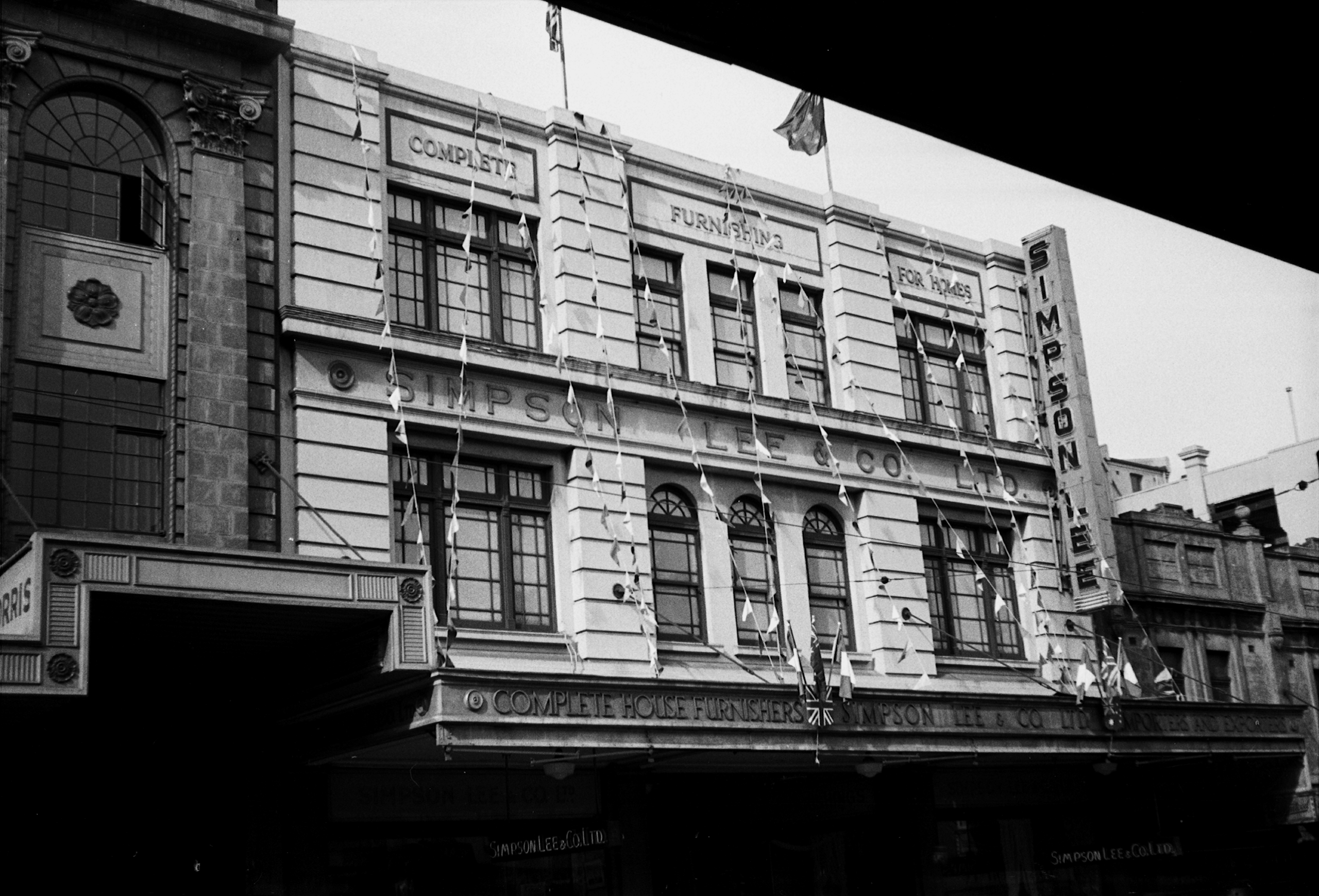
Wailum Simpson-Lee
The Simpson-Lee store exterior at 414-418 Pitt Street, Sydney, c.1950
Courtesy of Wailum Simpson-Lee
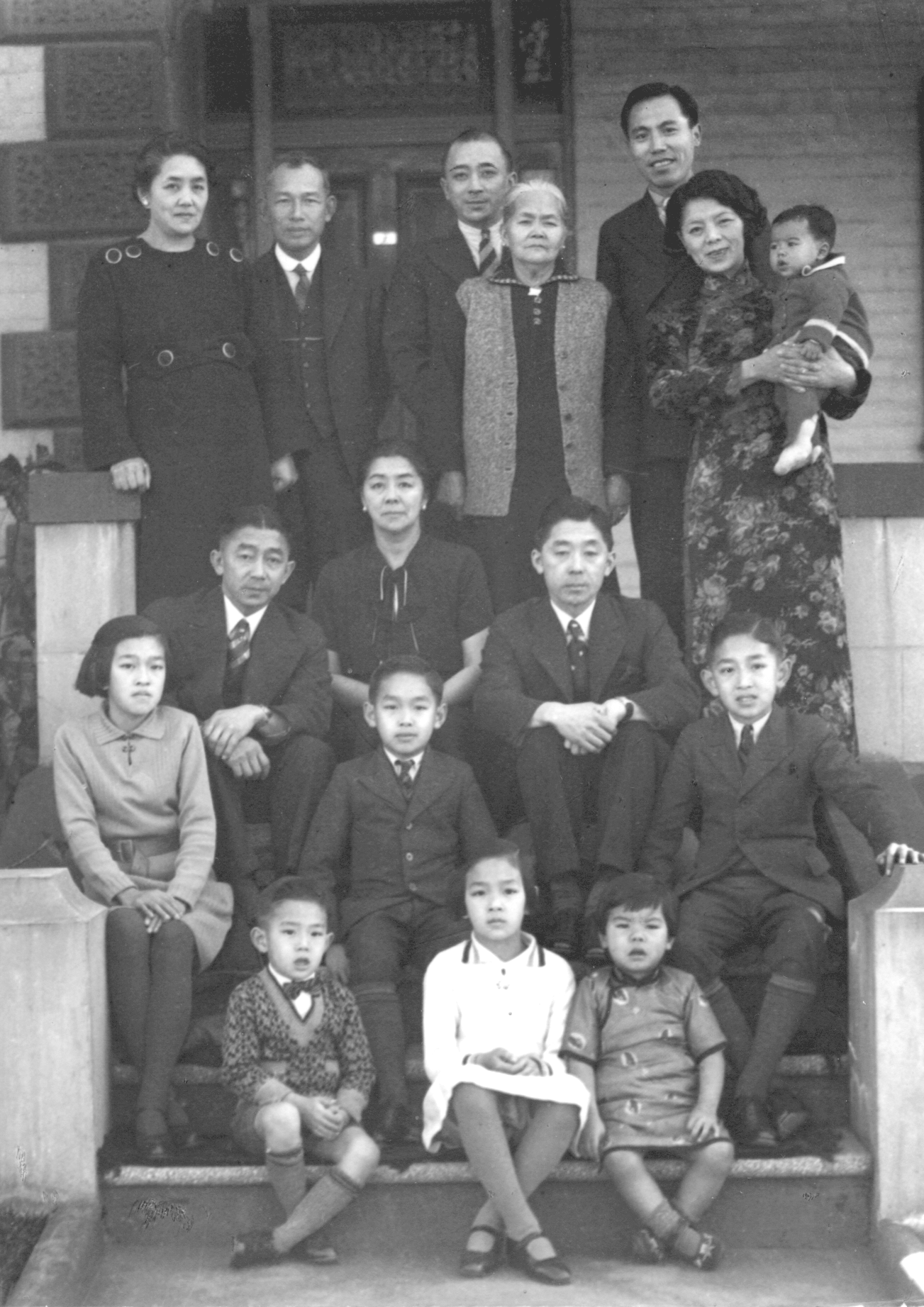
The gathering family photo of the Young Wai, Simpson-Lee and Yu Families, Summer Hill, NSW, 1935
Courtesy of Wailum Simpson-Lee
Modern China Café
新中国酒家
1940-1965
Pang Hung Jarm arrived in Sydney from Hong Kong in 1926 to manage a trading store owned by his father. In 1940, he opened the Modern China Café at 651 George Street in Haymarket. This was at a time that Chinese cuisine was gradually gaining popularity among non-Chinese Sydneysiders — due in part to Cantonese dishes being adapted to the Western palate.
Importantly, however, they succeeded in carving out a new kind of venue, which was often not in direct competition with existing local cafés or restaurants, offering different dishes prepared by their own Chinese chefs and kitchen staff.
With its elegantly designed Art Deco exterior and interior and its distinctive, modified Chinese menu, the Modern China Café remained an iconic dining spot for more than two decades. The restaurant not only played a key role in cultivating a more diverse food culture but also expanded dining experiences in post-war Sydney.
彭洪湛(Pang Hung Jarm)在1926年从香港來到雪梨(悉尼),管理其父商舖。1940年,他在禧市乔治街651号(651 George Street in Haymarket)开设"新中国酒家"。当时中餐粤菜经改良迎合西方人口味,正逐渐在雪梨(悉尼)非华裔居民中流行起來。
然而,更重要的是,他们成功开创了新型餐饮场所,不与当地现有咖啡馆或餐厅直接竞爭,而是由自己的中国廚师和廚房团队烹製,提供不同的菜肴。
"新中國酒家"拥有优雅艺术裝饰风格的外观和內部裝修,以及独具特色的改良中式菜单,在二十多年里一直是雪梨(悉尼/Sydney)标志性餐饮场所。它不仅在培育更多元化饮食文化方面发挥关键作用,同时拓展及丰富了战后雪梨(悉尼/Sydney)餐饮体验。
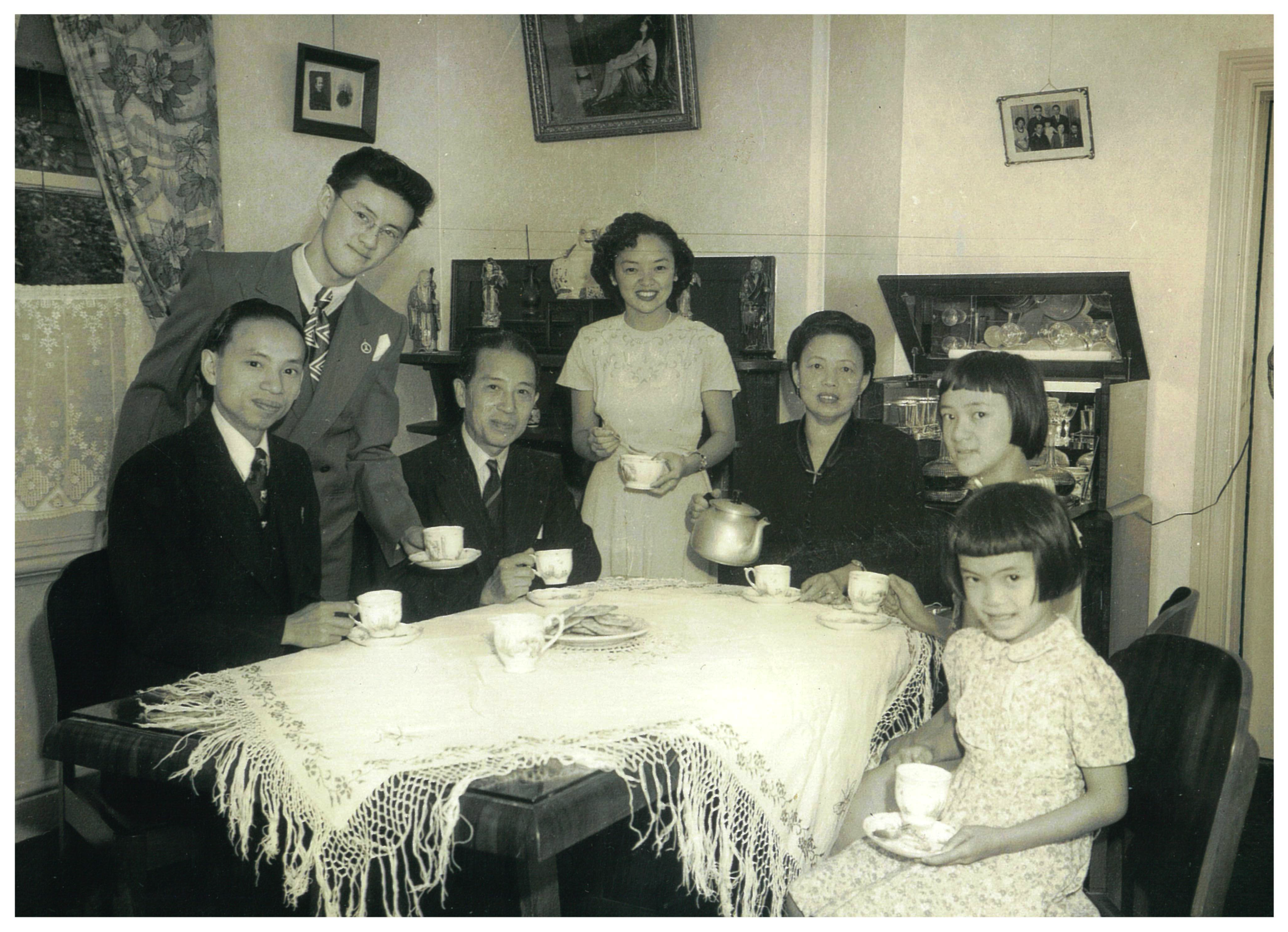
Pang Family at home, Sydney, late 1940s
Pang Family Collection, Museum of Chinese in Australia
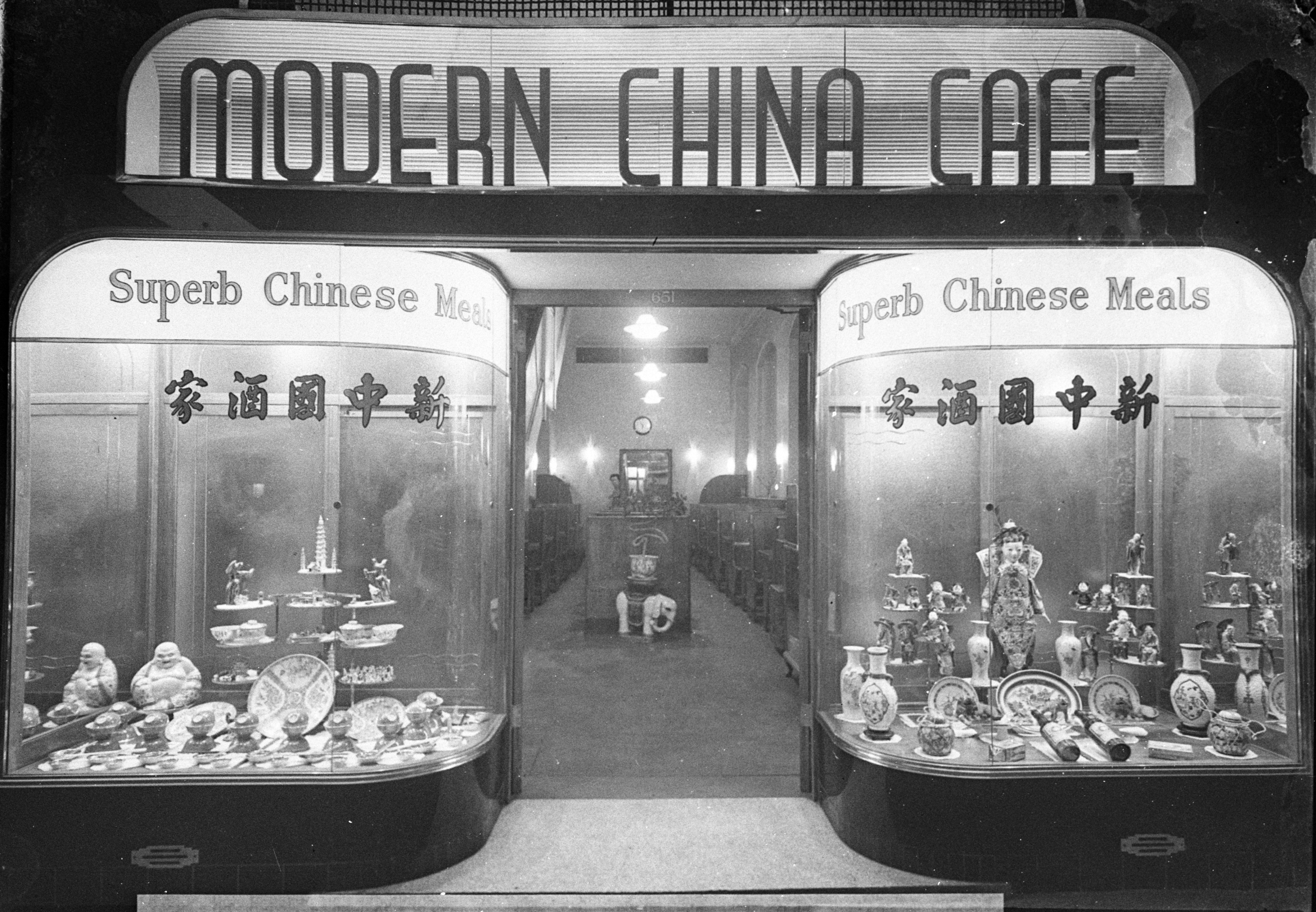
Sam Hood
Modern China Cafe, 651 George Street, Sydney, 6 September 1949
NCY61/55, State Library of New South Wales
Wing Sang & Co.
永生公司
1890–1984
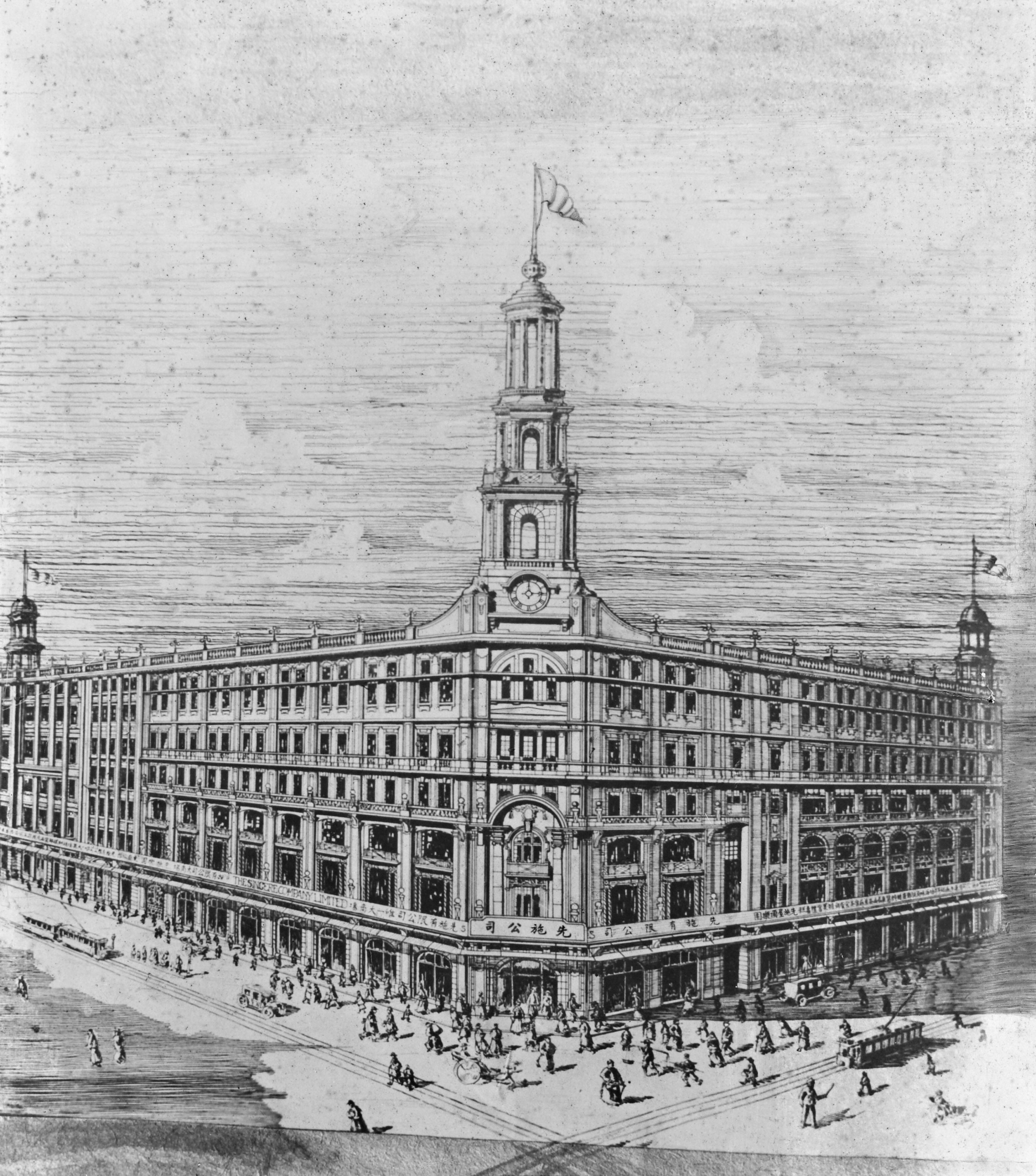
Wing Sang & Co. was an international fruit import-export business and remittance agency that operated in Haymarket from 1890 before relocating to Flemington Markets in 1972, where it remained in operation until 1984. The company was founded by Wing Chan Ma (Mark Joe), George Bew Kwok, Ma Ying Piu, James Choy Hing, all from the Zhongshan region of China's Guangdong province. Inspired by the Anthony Hordern & Sons' Palace Emporium on George Street, the founders and their families later established the famous "Four Great Department Stores" — Sincere, Wing On, Sun Sun and Da Sun — in Hong Kong and Shanghai during the early decades of the 20th century.
Wing Sang & Co. exemplifies the success of Chinese enterprise in Australia, leveraging profits from its mixed businesses and international networks to invest across the Asia-Pacific region. Its entrepreneurship in establishing department stores helped democratise shopping experiences and shaped urban consumption patterns in China in the first half of the 1900s.
永生公司(Wing Sang & Co)是国际水果进出口商及汇款代理公司。自1890年公司在禧市(Haymarket)开业,1972年搬迁至斐明顿市场(Flemington Markets),并在此经营至1984年。公司由马永灿(Wing Chan Ma (Mark Joe)、郭标(George Bew Kwok)、马应彪(Ma Ying Piu)和蔡兴(James Choy Hing)等四位创办人建立,他们皆來自中国广东省中山地区。他们受到位于悉尼乔治街(George Street)安东尼·霍登父子百貨公司(the Anthony Hordern & Sons)的启发,创始人及其家族在二十世紀初,在香港及上海创立了著名"四大百货公司"—— 先施(Sincere)、永安(Wing On)、新新(Sun Sun)和大新(Da Sun)。
永生公司是华人企业在澳洲成功的典范,它利用多元化业务和国际商务网络帶來的利润,在亚太地区进行投资。二十世紀上半叶,永生公司透过在中国创办百货公司,促进和实践大众化的购物体验并塑造了中国城市消费模式。
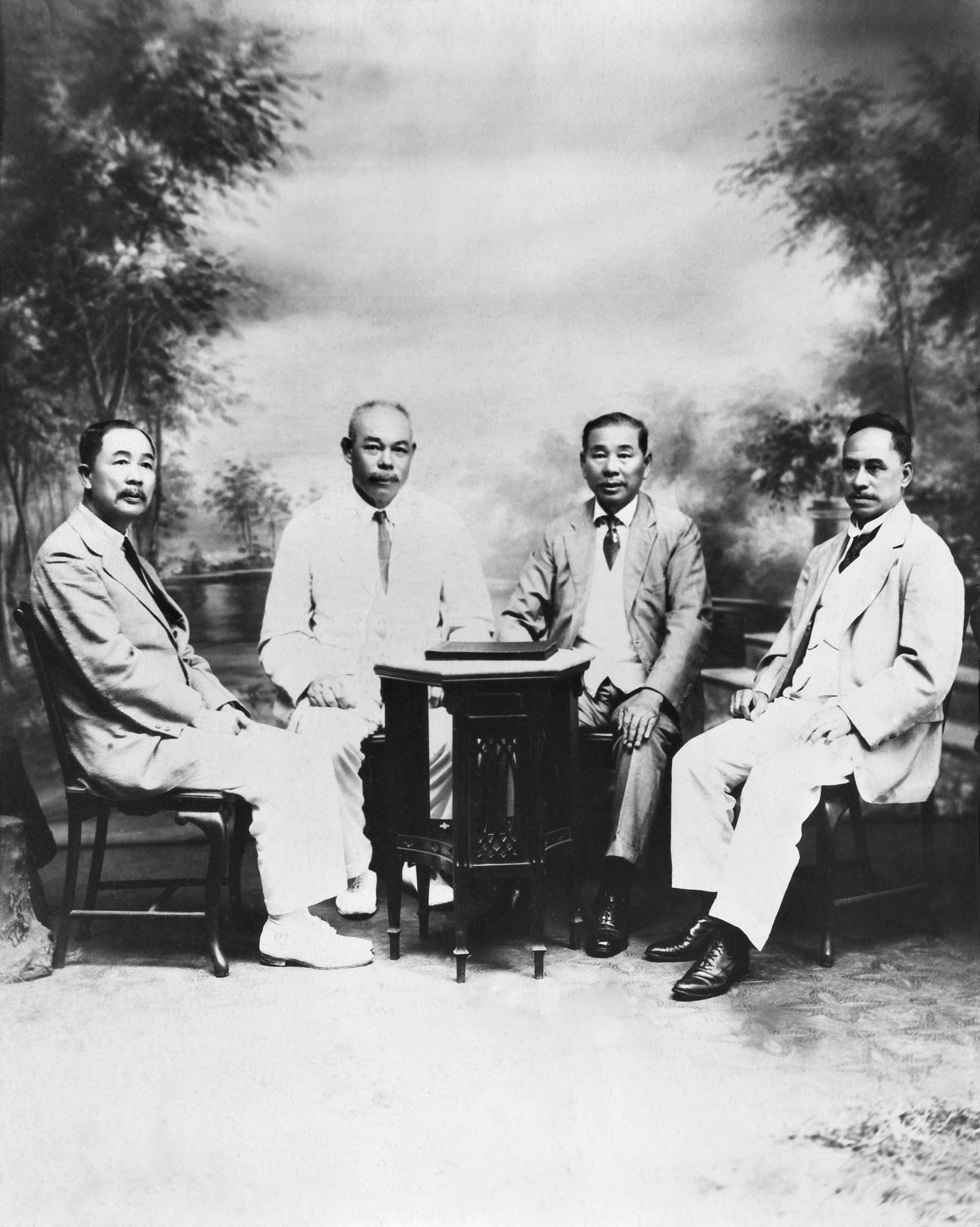
Founders of Wing Sang & Co., Sydney, 1890
059\059012
City of Sydney Archives
Courtesy of Gordon Mar
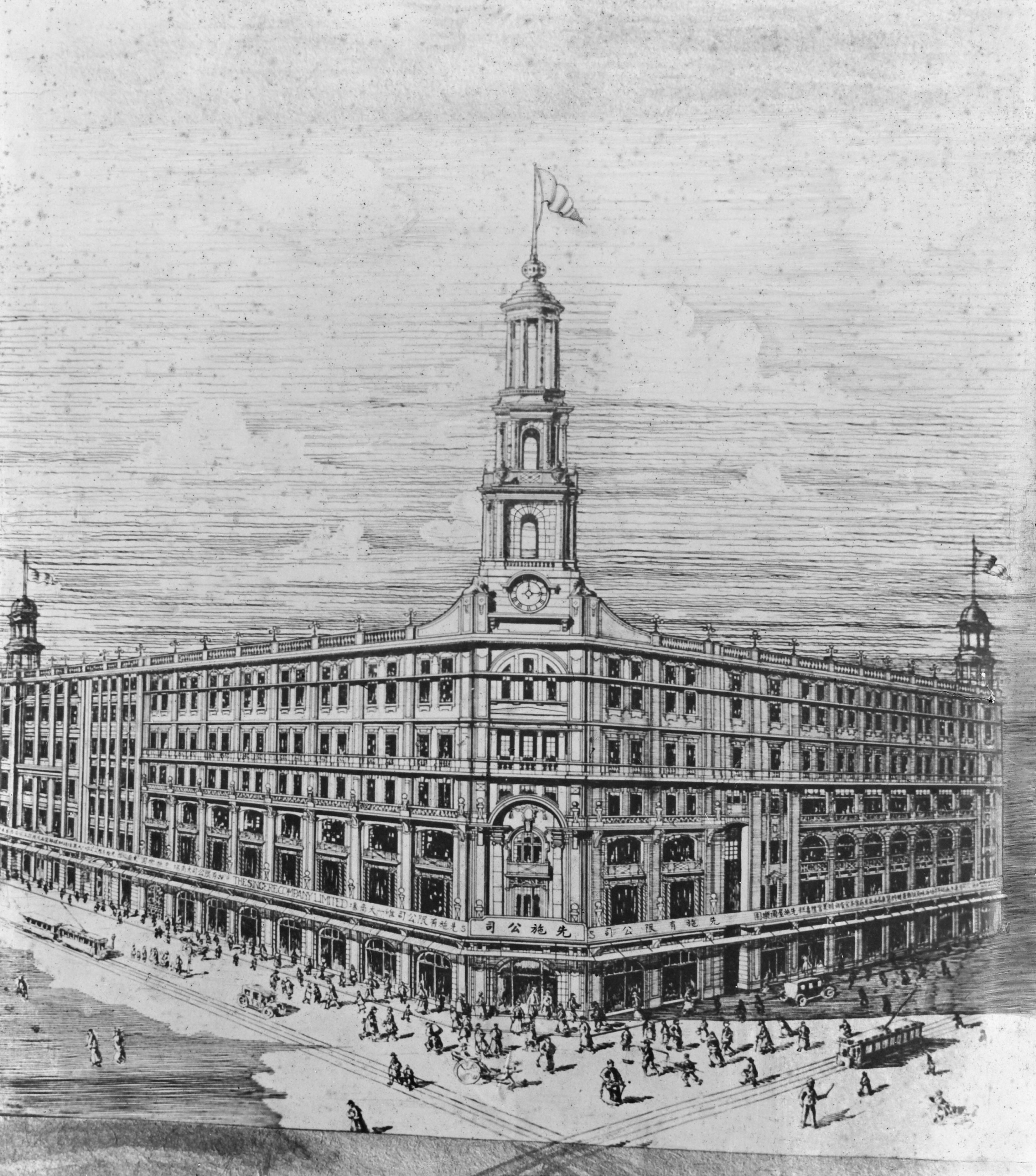
The Sincere Department Store in Shanghai, January 1910
059\059013
City of Sydney Archives
Courtesy of Gordon Mar